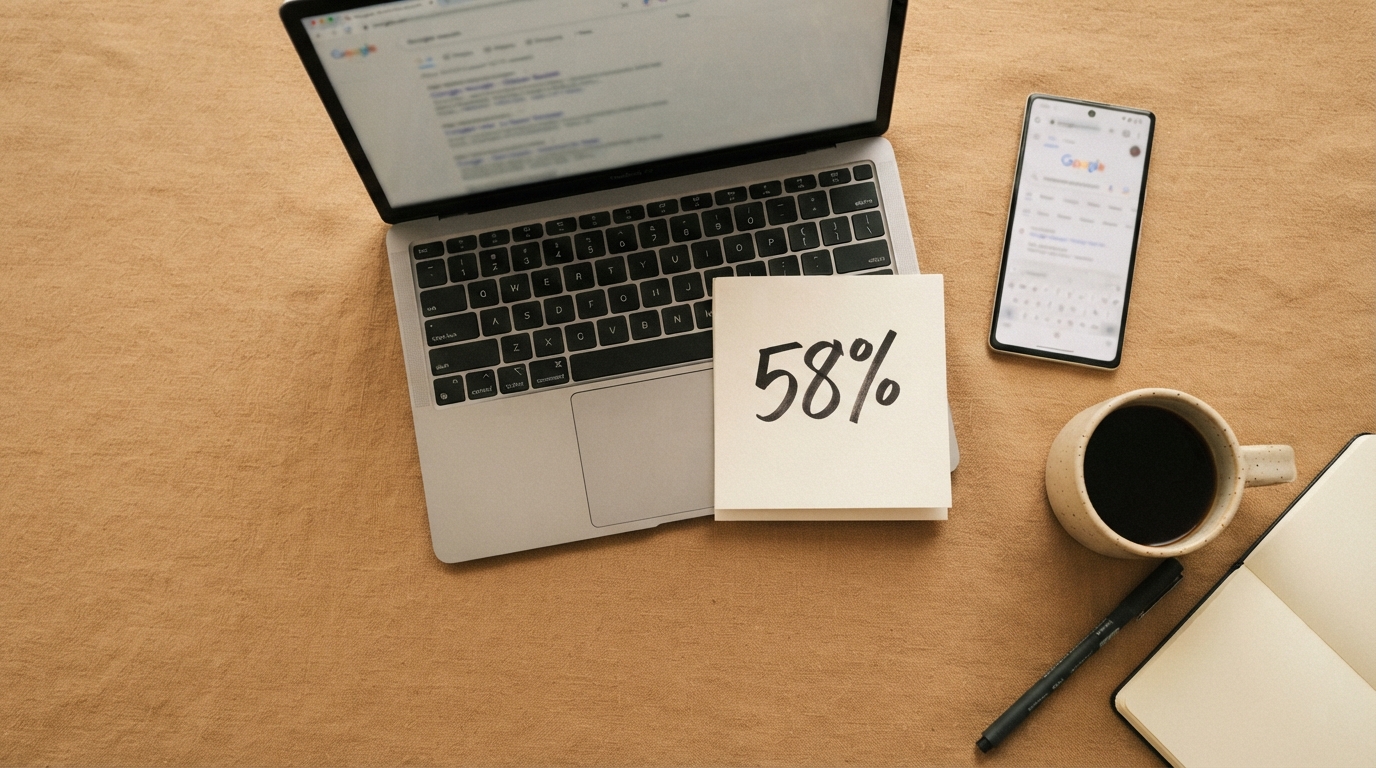

- 58% of Google searches now end without any website being visited
- AI Overviews appear on 48% of all searches and are still growing fast
- Brands cited in AI Overviews earn 120% more clicks than those that aren't
- Only 38% of AI-cited pages also rank in the traditional top 10
- Generative Engine Optimisation (GEO) is the new layer every site needs
If you Googled something today, there's a good chance you got your answer without clicking a single link.
That's not a prediction. It's already happening. According to research from SparkToro and Datos, 58% of Google searches now end in what's called a "zero-click search," where Google answers the question directly on the results page and the searcher never visits a website.
For small business owners who rely on Google to bring in customers, that number should feel like a wake-up call.
What changed?
In the last 18 months, Google has rolled out AI Overviews to more than 200 countries and 40 languages. These are AI-generated summaries that appear at the top of search results, pulling information from multiple websites and presenting it as a single, neat answer.
A 58% year-on-year increase, and the number is still climbing. Source: Semrush
When someone searches "best way to market a small business" or "how much does a website cost," Google's AI now writes a summary answer right there on the page. The person reads it, gets what they need, and moves on. No click. No website visit. No chance for your business to make an impression.
The numbers that matter
Here's what the data shows:
If companies with enormous SEO budgets and dedicated marketing teams are losing ground, a five-page brochure website with generic content doesn't stand a chance.
But here's the opportunity
Before you panic, there's a flip side to this that most people aren't talking about.
Brands cited inside Google's AI Overviews earn approximately 120% more organic clicks than brands that don't get cited on the same queries. Being referenced by the AI doesn't just maintain your visibility. It amplifies it.
And here's something that surprises most people: only 38% of pages cited in AI Overviews also rank in the traditional top 10 search results. That's down from 76% just seven months ago. Google's AI is increasingly pulling from a wider, more diverse set of sources.
AI citations now pull from a far wider source pool than classic SEO rankings. Source: Ahrefs / ALM Corp
What that means in practical terms: you don't need to be a massive brand or have a huge SEO budget. You need content that AI systems recognise as authoritative, specific, and well-structured. A small business that creates genuinely helpful, detailed content about their area of expertise can absolutely get cited by AI, even if they've never ranked on page one before.
What does this mean for your business?
The strategy for getting found online has fundamentally changed. It's no longer enough to rank on page one and hope people click. You now need to optimise for two things at once:
Traditional SEO
Still matters. People still click links, especially for commercial and local searches. If someone's searching for "web designer Sunshine Coast," they're going to click through to websites. You still need to be there.
- Page-one keyword rankings
- Technical performance
- Local search presence
- Backlink authority
Generative Engine Optimisation
Structuring your website and content so that AI systems (Google's AI Overviews, ChatGPT, Perplexity, Claude) can find, understand, and cite your content as a source.
- Structured data and schema
- Topical depth and authority
- AI-parseable site architecture
- Clear, specific, expert content
GEO isn't a buzzword. It's a specific set of practices: structured data, topical depth, clear and authoritative content, and a site architecture that AI crawlers can parse efficiently. Most websites built more than two years ago weren't designed with any of this in mind.
Three things you can do right now
Search for terms your customers would use. See if Google's AI summary mentions your business or cites your website. If it doesn't, that's your starting point.
Does your website have detailed, specific content about what you do and who you help? Or is it generic "we offer great service" copy that could belong to any business in your industry? AI systems cite sources that demonstrate genuine expertise. Stock content gets ignored.
This isn't something you can fix by adding a plugin or tweaking a few meta descriptions. It requires thinking about your site's structure, your content strategy, and how AI systems evaluate authority. If your website was built more than two years ago, it's likely invisible to the way a growing number of people search today.
The bottom line
Google isn't broken. It's evolving. And the businesses that evolve with it will end up with more visibility, not less. But the window to get ahead of this is right now, while most small businesses haven't even heard of AI Overviews, let alone optimised for them.
"At Sonder Digital, we build every website with both traditional SEO and Generative Engine Optimisation baked in from day one. Not as an add-on. Not as an afterthought. Because in 2026, a website that only works for traditional search is a website that's already falling behind."
If you want to understand how your business shows up in AI search results, we'd love to have that conversation.
Is your website ready for AI search?
We'll audit how your business appears in Google's AI Overviews and show you exactly what to fix. Free, no obligation.
Book a free discovery call- SparkToro / Datos: Zero-click search data, 2026
- Semrush: AI Overview prevalence tracking, 2025-2026
- Seer Interactive: Brand citation impact in AI Overviews, 2026
- Ahrefs / ALM Corp: AI Overview citation overlap analysis, 2026
- Gartner: Organic traffic shift projection, 2026
- Press Gazette / Reuters Institute / Chartbeat: Publisher traffic impact, 2026